
Ajit Mishra, vice president, Research, Religare Broking, answers your queries.

Four banks -- Bank of Rajasthan (16 per cent), ING Vysya Bank (14.66 per cent), South Indian Bank (10 per cent) and Karnataka Bank (8.67 per cent) -- have sold their stakes aggregating 49.33 per cent in BhOB to IOB.
.jpg)
Domestic shares jumped nearly 1.5 per cent on Monday to an all-time high, surpassing their previous record hit just last week, as lenders including ICICI Bank extended a recent rally.

Ajit Mishra, vice president, Research, Religare Broking, answers your queries.

Kerala floods take a toll on small businesses, NBFCs brace for losses
Animation is going to be big business in India, and the country can create talents rapidly
Forex dealers said though increased demand for the US currency from importers put pressure on the rupee but a higher opening in the domestic equity market and the dollar's rise against other currencies overseas, capped the losses.

Ajit Mishra, vice president, Research, Religare Broking, answers your stock market queries.

The state government has 35 per cent stake in the airport, and the terminal would have the capacity to handle 2,000 passengers at a time, Minister for Ports and Airport K Babu said in Thiruvananthapuram on Friday.

Traders are looking ahead at the consumer prices data due on Wednesday, amid rising expectation the Reserve Bank of India could opt for earlier-than-expected cuts in interest rates should inflation continue to ease.

Ajit Mishra, vice president, Research, Religare Broking, answers your queries.

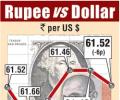
The partially convertible rupee closed at 61.45/46 per dollar, weaker from Wednesday's 61.35/36.
Most dealers said the heavy buying by state-run banks was on behalf of the central bank, looking to limit the volatility in the rupee, in the face of foreign fund flows into the share market.

Ajit Mishra, vice president, Research, Religare Broking, answers your queries.

Ajit Mishra, vice president, Research, Religare Broking, answers your queries.
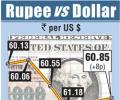
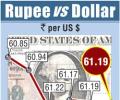
On Monday, the rupee recovered from four-month low by rising 25 paise in its biggest gain in three weeks to end at 60.93 against the Greenback as shares soared ahead of the RBI's bi-monthly policy meet and exporters offloaded dollars.
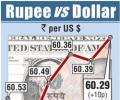
The rupee resumed higher at 59.69 per dollar as against the last closing level of 59.73 at the Interbank Foreign Exchange market.
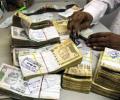
The rupee resumed higher at 60.13 per dollar as against the last closing level of 60.20 at the Interbank Foreign Exchange market, and hovered in a range of 60.07 and 60.18 per dollar before quoting at 60.08 at 1000 hours.
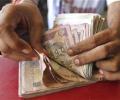
Central bank steps up dollar purchases to check rupee gains
The US and European Union on Monday announced a round of sanctions against Russian officials.

Though most experts remain bullish on the banking space, they suggest investors buy only those banks whose NPAs are at a manageable level of 3% to 4% and there is credit growth or earnings visibility.
In New York, the US dollar swung higher against many of its rivals on Wednesday.
In New York, the dollar fell against the British pound on Wednesday after the Bank of England raised its projections for UK growth in 2014. However, analysts warned that gains against the dollar could be limited.

Ajit Mishra, vice president, Research, Religare Broking, answers your queries

The partially convertible rupee closed at 61.5350/5450 per dollar compared to 61.54/55 on Wednesday.
Forex dealers said besides increased selling of the American currency by exporters and banks, the dollar's weakness against other currencies overseas also supported the rupee, but a lower opening in the domestic equity market limited the rise.
.jpg)
The rupee resumed slightly lower at 62.05 per dollar as against the last weekend's level of 62.04 at the Interbank Foreign Exchange market. It recovered to 61.88 per dollar before quoting 61.93 at 1045 hours.
Forex dealers said besides increased selling of the American currency by exporters and banks, a higher opening in the domestic equity market and the dollar's weakness against other currencies overseas supported the rupee.
The RBI's macroeconomic report released after the close of markets said upside risks to food inflation remain and that it expects the retail and wholesale price inflation to remain above comfort levels.

The Indian currency resumed lower at 61.50 per dollar as against the last closing level of 61.46 at the Interbank Foreign Exchange Market.

How did marquee Dalal Street investors fare in the Jan-Mar quarter that saw the BSE Sensex tank 10 per cent?
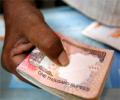
Traders also say oil-related dollar demand is capping broader gains in the rupee.
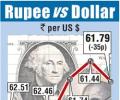
Traders say the rupee and other global currencies will likely track the continued uncertainty in the US budget stalemate and government shutdown.

Quite a few large- and mid-cap stocks are yet to recover from the note ban, pharma, banking and rural demand-based industries among laggards.
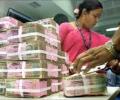
In New York, the US currency fell against the Australian dollar and British pound on Monday as investors continued to weigh the potential weather drag on recent economic data, and whether or not it could sway monetary policy.
.jpg)
The rupee has avoided the heavy losses suffered by some emerging Asian currencies such as the Philippine peso this year because of its efforts to narrow the current account deficit, and strong foreign investor inflows.

'Experience of administration may make a member of civil service a good administrator but not necessarily an able and impartial adjudicator,' observes the Supreme Court.

'Kerala isn't as dependent on agriculture like Bihar or Odisha or even other southern states.' 'Economic losses would not be too intense, unlike other states.' 'The floods could, at best, impact India Inc's earnings for a quarter or two.'
